How Many Fall Cleanups Fit in One Load? A K-Trail Dump-Trailer Capacity Planner for Landscaping Crews
September 3, 2026 by Kyle McFarlane
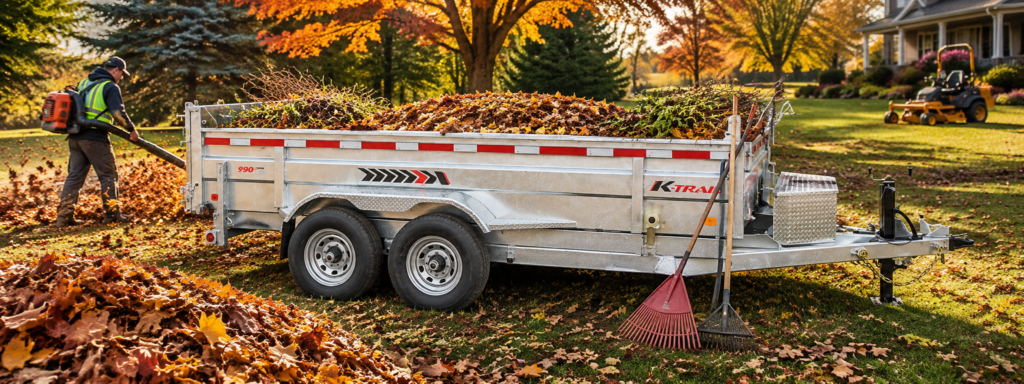
Fall cleanup season can turn a productive landscaping route into a series of dump-site runs. Leaves and brush fill a trailer quickly, and choosing the right capacity can mean the difference between finishing several properties in one load and losing valuable time unloading halfway through the day.
A K-Trail dump trailer for landscaping can make seasonal cleanup more efficient, but capacity isn’t just about box size. Leaves, brush, soil, mulch, and gravel all load differently. This guide will help you estimate how many fall cleanups your trailer can handle while balancing volume, payload, and practical hauling needs.
What Size Dump Trailer Do I Need for Fall Cleanups?
For most fall cleanups, choose a dump trailer based on the volume of leaves and brush you typically collect, as well as the trailer’s available payload. Lightweight leaves usually fill the trailer by volume first, while wet yard waste, soil, and gravel can reach payload limits much sooner. The right size depends on your properties, materials, tow vehicle, and daily workload.
Start With Cubic Yards: How Much Space Does a Fall Cleanup Use?
When hauling leaves and yard waste, cubic yards tell you how much material can physically fit inside the trailer. This is especially important during fall cleanups because dry leaves are relatively light but take up a lot of space. A trailer can look completely full while still being well below its maximum payload.
To estimate how many cleanups you can fit in one load, start by estimating how many cubic yards of debris an average property produces. For example, if a typical cleanup generates about 3 cubic yards of leaves and brush and your trailer provides 12 cubic yards of usable space, you could theoretically fit about four similar cleanups before unloading.
Keep in mind that yard waste rarely packs perfectly. Loose leaves settle, while branches and hedge trimmings can leave large pockets of unused space. Wet leaves also weigh considerably more than dry ones. Treat your calculation as a planning estimate and leave some extra capacity rather than assuming every cubic yard of trailer space will be usable.
A simple formula can help when planning your route:
Approximate cleanups per load = usable trailer volume ÷ estimated cubic yards of debris per cleanup
Tracking the amount of debris collected from your regular properties can make these estimates more accurate over time. For landscaping crews with recurring routes, this can help determine when to schedule dump runs and which trailer capacity best matches a typical workday.
Leaves vs. Brush: Why the Same Trailer Can Hold Very Different Loads
Not all fall debris uses trailer capacity the same way. A dump trailer for leaves and yard waste may fill to the top with dry leaves while remaining well below its payload limit. Add wet leaves, grass clippings, or heavier debris, and weight can become a concern much sooner.
The type and condition of the material can make a significant difference:
- Dry leaves: Lightweight but bulky, so available space is usually the main limitation.
- Wet leaves: Heavier and more compact than dry leaves, making payload more important after rainy weather.
- Brush and branches: Relatively light for their size, but irregular shapes can create empty pockets and use trailer space inefficiently.
- Hedge trimmings: Often compact more easily than branches, but can still consume considerable volume on larger properties.
- Mixed yard waste: A combination of leaves, branches, grass, and other debris can make both volume and weight harder to estimate.
Crews can make better use of available capacity by loading material evenly and breaking down bulky brush when practical. However, fitting more into the box should never come at the expense of safe loading. Stay within the trailer’s rated payload, distribute the load properly, and secure loose yard waste before travelling.
Fall Cleanup Load-Planning Table: Leaves, Brush, Soil, Mulch and Gravel
Volume is only half of the equation when planning a dump trailer load. Material density can vary considerably, especially when moisture is involved. The estimates below can help landscaping crews compare common materials and determine whether trailer space or payload is more likely to become the limiting factor.
| Material | Approx. Weight per Cubic Yard | Relative Weight | Usually Limited By | Planning Tip |
| Dry leaves | 100 to 300 lb | Light | Volume | Expect the trailer to fill before reaching its payload limit |
| Wet leaves | 300 to 600+ lb | Moderate | Volume and payload | Leave additional payload capacity after rain |
| Brush and branches | 150 to 500 lb | Light to moderate | Volume | Break down bulky branches to reduce empty space |
| Mulch | 400 to 800 lb | Moderate | Volume and payload | Estimate cubic yards before loading |
| Soil | 1,800 to 2,700 lb | Heavy | Payload | A few cubic yards can add substantial weight |
| Gravel | 2,400 to 3,000+ lb | Very heavy | Payload | Calculate weight carefully before filling the trailer |
These figures are general planning estimates. Actual weight can vary based on moisture, compaction, material type, and other conditions. A simple calculation can provide a rough load estimate:
Estimated load weight = cubic yards of material × estimated weight per cubic yard
For example, 3 cubic yards of soil at an estimated 2,000 pounds per cubic yard would weigh about 6,000 pounds. Before loading, always check the specific trailer’s GVWR, empty weight, available payload, axle ratings, and tire ratings, along with the tow vehicle and hitch limits. Never use estimated material weights as a substitute for the manufacturer’s specifications or an actual measured load weight.
How Many Fall Cleanups Can You Actually Fit in One Load?
Once you know your trailer’s usable volume and the approximate amount of debris each property produces, you can estimate how many stops will fit into one load. For leaf-heavy cleanups, volume will often determine when it is time to unload.
Consider a landscaping crew using a trailer with about 12 cubic yards of usable space:
- Small cleanup: At 1 to 2 cubic yards of debris per property, roughly 6 to 12 cleanups could fit based on volume alone.
- Average cleanup: At around 3 cubic yards per property, approximately four cleanups could fit in one load.
- Large cleanup: At 5 to 6 cubic yards per property, the trailer may hold only two cleanups before a dump run is needed.
- Mixed-material cleanup: If the load includes wet leaves, soil, sod, or other dense materials, payload may become the limiting factor before the available space is used.
These numbers are planning examples rather than guaranteed load counts. Leaves can settle during transport, branches create empty pockets, and wet material can add significant weight.
For landscaping crews, the goal is not necessarily to fit the maximum possible amount into every load. A better approach is to leave a reasonable capacity buffer and plan dump runs around the properties on your route. This helps keep loads within the trailer’s ratings while reducing unnecessary trips to the disposal site.
When a Larger K-Trail Dump Trailer Can Reduce Dump Runs
For landscaping and property-maintenance crews, every trip to the disposal site takes time away from the next job. If your trailer regularly fills with leaves and brush after only one or two properties, moving to a larger K-Trail dump trailer for landscaping could help your crew complete more stops between dump runs.
Fewer dump runs can provide several practical benefits:
- More productive hours: Crews can spend more of the workday completing cleanups instead of travelling to and from disposal sites.
- Lower travel costs: Fewer trips can help reduce fuel use and unnecessary mileage on the tow vehicle.
- Better route planning: Additional capacity makes it easier to group several nearby properties before unloading.
- Less disruption: Crews can move from one customer to the next without stopping halfway through a route to empty the trailer.
- Greater versatility: A properly selected dump trailer can handle fall leaves and brush while also supporting mulch, soil, and other landscaping work throughout the year.
Bigger is not always better, though. A larger trailer may require a more capable tow vehicle, and it can be harder to maneuver in tight residential driveways or crowded job sites. The best choice is a trailer that provides enough capacity for your typical route while staying within your vehicle’s towing limits and the trailer’s rated payload.
Don’t Confuse Box Capacity With Payload Capacity
A dump trailer may have plenty of room left in the box and still be approaching its safe weight limit. This is why landscapers need to consider both cubic-yard capacity and payload when planning a load.
Cubic-yard capacity measures how much space is available in the trailer, while payload refers to how much cargo weight the trailer can carry. Available payload can generally be estimated with this formula:
Available payload = GVWR – empty trailer weight
For example, dry leaves may fill the entire box without coming close to the trailer’s payload limit. Soil and gravel are very different. These dense materials can reach the payload limit while leaving a significant amount of empty space in the box.
Before heading to the next job, crews should consider several ratings and limits:
- GVWR: The maximum allowable loaded weight of the trailer.
- Payload capacity: The amount of cargo the trailer is rated to carry.
- Axle and tire ratings: These help determine how much weight the trailer components can safely support.
- Tow vehicle capacity: The vehicle must be properly rated for the loaded trailer.
- Hitch and tongue weight: Proper ratings and weight distribution are important for safe towing.
- Load distribution: Material should be positioned appropriately rather than concentrated in one area of the trailer.
Always confirm specifications for the exact K-Trail model, tow vehicle, hitch, and equipment being used. When hauling heavy landscaping materials, the trailer looking “not full” does not necessarily mean there is room for more.
Choosing a K-Trail Setup for Landscaping and Property Maintenance
The right K-Trail setup should match more than your busiest week of fall cleanups. Landscaping crews often use the same trailer for brush in the spring, mulch and soil in the summer, and leaves throughout the fall. Choosing a versatile setup can help keep the trailer useful throughout the working season.
When comparing K-Trail dump trailers, consider:
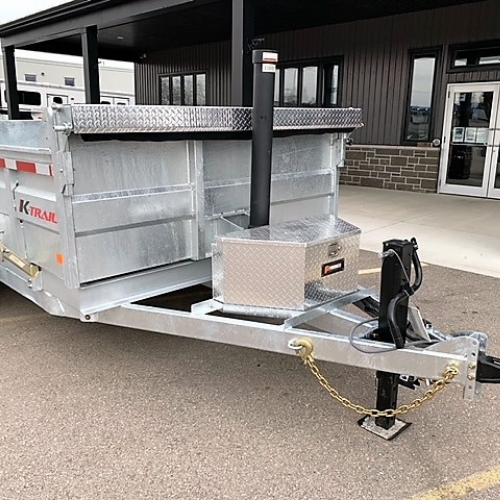
- Box dimensions: Longer or taller boxes can provide additional room for bulky leaves, branches, and yard waste.
- Payload capacity: Make sure the trailer is suited to the heaviest materials you regularly expect to haul.
- Side height: Higher sides or compatible extensions can provide useful volume for lightweight, bulky debris.
- Loading access: Consider how easily crews can load leaves, wheelbarrows, equipment, and other materials.
- Dump system: A reliable dumping system can make unloading at disposal sites or jobsites faster and more convenient.
- Tarp options: A suitable tarp system can help contain loose leaves and yard waste during transport.
- Ramps: If available on the specific model, ramps may be valuable for crews that need to transport landscaping equipment between jobs.
For contractors, the goal is to find a K-Trail dump trailer that works for both high-volume debris and heavier landscaping materials without exceeding its rated limits. Homeowners should apply the same principle on a smaller scale, choosing a trailer that fits their property-maintenance needs and the capabilities of their tow vehicle.
A Quick Pre-Load Checklist for Fall Cleanup Crews
A few minutes of planning before the first property can make the entire cleanup route more efficient. Before loading your dump trailer for leaves and yard waste, consider what you will be hauling, how much space it will require, and how quickly the weight could add up.
Use this quick checklist before heading out:
- Estimate how many cubic yards of debris you expect to collect from the day’s properties.
- Identify the main materials, such as leaves, brush, mulch, soil, or gravel.
- Account for rain or moisture that could make leaves and other yard waste heavier.
- Confirm the trailer’s available payload, GVWR, axle ratings, and tire ratings.
- Make sure the tow vehicle and hitch are properly rated for the expected loaded trailer weight.
- Distribute material appropriately instead of concentrating excessive weight in one area.
- Secure loose leaves, branches, and other debris before travelling.
- Plan your disposal stops so the crew can complete as many properties as practical without overloading the trailer.
Making these checks part of your fall routine can help reduce unnecessary dump runs while keeping capacity and payload limits at the centre of your load planning.
Plan the Load Before You Plan the Route
The right dump trailer can make fall cleanup routes faster and easier to manage. Leaves and brush tend to use up trailer volume first, while soil, gravel, and wet yard waste can push payload limits much sooner. Knowing what you haul and how much each property typically produces can help you plan loads with fewer surprises.
For landscaping crews, property-maintenance companies, and homeowners, a K-Trail dump trailer can provide useful capacity for fall debris while staying versatile for mulch, soil, brush, and other projects throughout the year. The key is choosing a trailer that matches your workload, materials, and tow vehicle.
Ready to find the right setup? Browse the current K-Trail dump trailer inventory at McFarlane Trailer Sales, or contact the team for a payload and capacity consultation. Tell us what you haul, how many properties you typically service, and what you tow with, and we can help you narrow down the K-Trail options that fit your needs.